The DentalBrace
Clinic & Implant Centre
Treatment Snapshot
Dentofacial orthopedics involves guiding the growth and development of a child's facial bones to correct severe skeletal imbalances before they stop growing.
Why Patients Choose This
- • Early dentofacial intervention can prevent the need for invasive jaw surgery in adulthood.
- • Orthopedic appliances can expand a narrow palate, resolving chronic mouth-breathing and sleep apnea in children.
- • Correcting jaw growth creates a highly harmonious and attractive facial profile.
When To Consider Alternatives
Dentofacial orthopedics is generally ineffective in adults, as their facial bones have completely fused and stopped growing.
Post-Treatment Maintenance
Removable orthopedic appliances must be worn consistently as prescribed and cleaned daily with mild soap and water.
What is Dentofacial Orthopedics?
While standard Orthodontics involves moving teeth into alignment, Dentofacial Orthopedics involves guiding the growth and development of the facial bones (the upper and lower jaws) in children. If a child’s upper jaw is too narrow, or their lower jaw is growing too slowly (causing a severe overbite), waiting until they are teenagers to apply braces is often too late—by then, the bones have fused, and correcting the discrepancy may require brutal orthognathic jaw surgery. By intercepting these issues early (between the ages of 7 and 10) during active growth spurts, Dr. Sandeep Kumar can use specialized appliances (like Palatal Expanders, Headgear, or Functional Twin Blocks) to physically widen the palate or accelerate lower jaw growth. This not only prevents severe dental crowding and surgical interventions later in life, but it radically improves the child’s airway. Narrow jaws are a leading cause of mouth breathing, snoring, and pediatric sleep apnea, which severely impacts a child’s cognitive development and behavior.
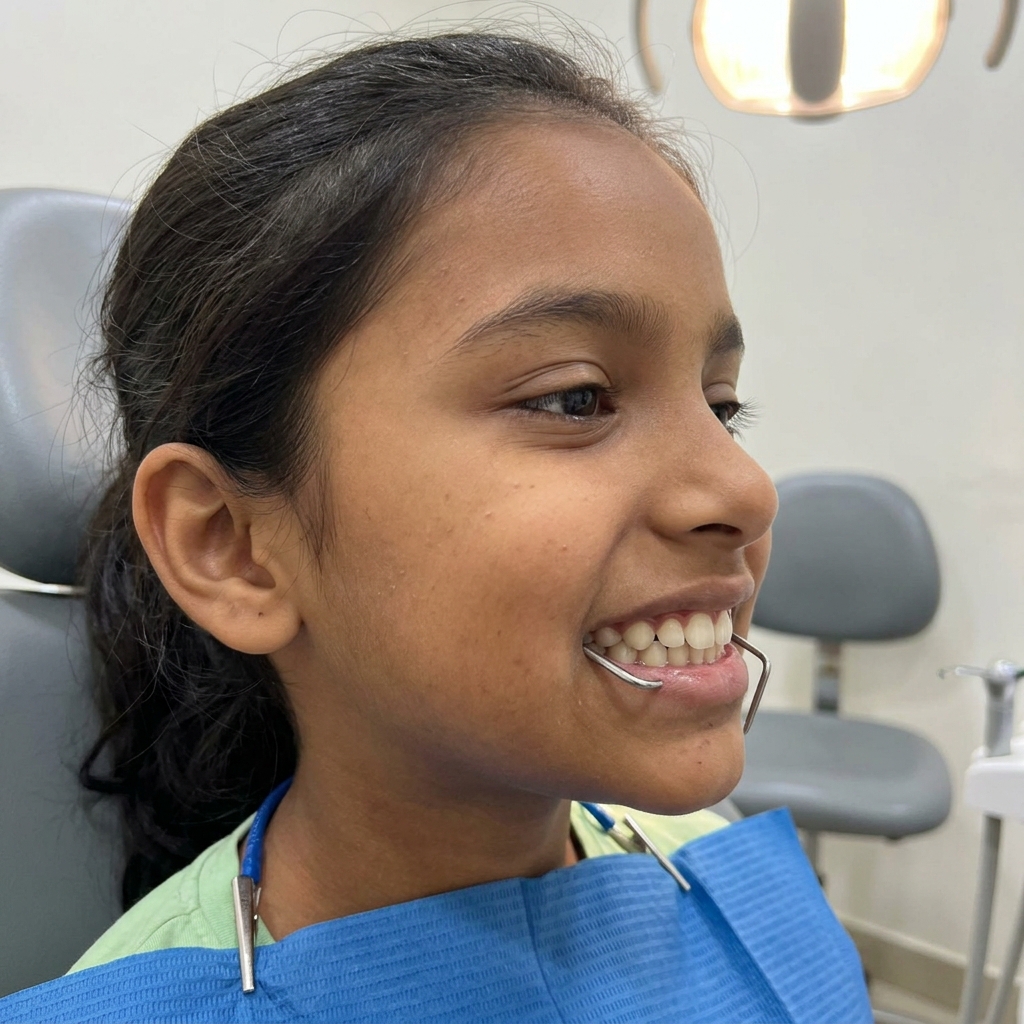
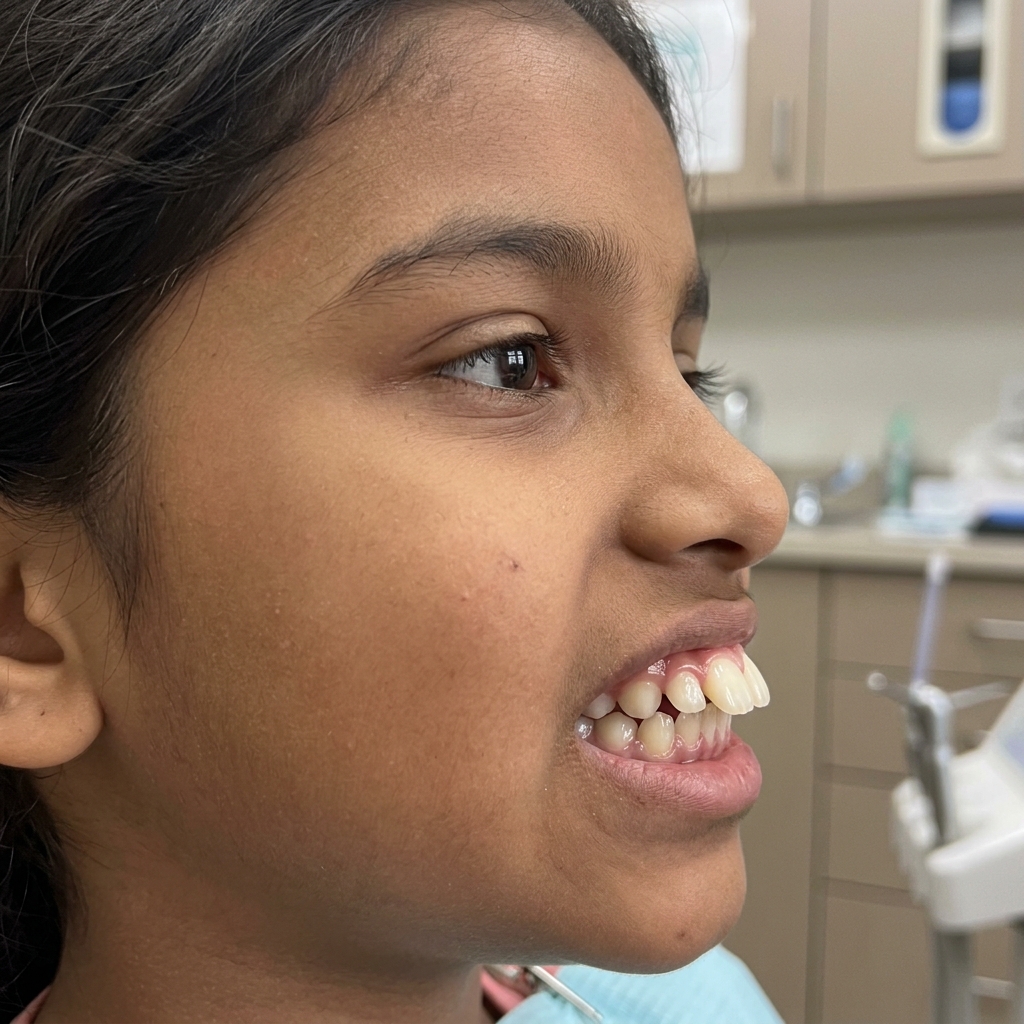
Before & After Results
Signs You Need This Treatment
- ✓ Severe overbite (buck teeth) or underbite (bulldog bite)
- ✓ Mouth breathing, snoring, or sleep apnea in children
- ✓ Thumb sucking or tongue thrusting past age 5
- ✓ Crossbite (upper teeth sit inside lower teeth)
- ✓ Visibly narrow face or recessed lower jaw (weak chin)
Possible Limitations
- Highly dependent on the child’s compliance to wear the removable appliances
- Must be timed perfectly with the child’s biological growth spurts
Ideal Candidate
Growing children between the ages of 7 and 11. Early intervention (Phase 1 Orthodontics) takes advantage of the natural growth spurts before the skeletal sutures fuse.
Not Recommended For
Adults. Once facial growth is complete (usually by age 16-18), orthopedic appliances cannot widen or lengthen the jaw bones. At that point, jaw surgery is the only option.
Key Benefits
- Prevents the need for severe jaw surgery in the future
- Widens the airway, curing mouth-breathing and improving sleep quality
- Creates adequate space for adult teeth to erupt, preventing extractions
- Dramatically improves facial aesthetics and profile symmetry
- Simplifies later treatment with braces or Invisalign
Step-by-Step Process
Orthodontic & Airway Screening
At age 7, we take a Cephalometric X-ray to analyze the relationship between the upper jaw, lower jaw, and cranial base.
Custom Appliance Fabrication
If a discrepancy is found, digital scans are taken to fabricate a custom orthopedic appliance (like an expander or Twin Block).
Appliance Fitting
The appliance is fitted. Some are glued in permanently (fixed), while others are removable and must be worn specific hours a day.
Growth Modification & Progress Reviews
Over 9-18 months, the appliance guides jaw bone growth. Routine monitoring is conducted in-clinic and via online video conference checkups for outstation families.
Resting Phase
Once the skeletal foundation is corrected, we wait for the remaining adult teeth to erupt before evaluating if a short phase of braces is needed.
Recovery & Expectations
Timeline: When an appliance like an expander is fitted, the child will feel pressure on the roof of the mouth and teeth. Speech may be affected for 3-4 days as the tongue adapts to the appliance.
Success Factors: Absolute strict compliance in wearing removable appliances for the prescribed hours, Parents actively turning the expander key as instructed by the orthodontist
When to Consult: The global orthodontic standard dictates that EVERY child must have an orthodontic screening by age 7. This is the critical window where jaw growth can be easily manipulated.
Appointments: Appointments every 4-6 weeks to adjust the orthopedic appliances and monitor growth.
The most heartbreaking cases are 18-year-olds who come in with severe jaw discrepancies that require invasive surgery, simply because they weren't screened at age 7. We can literally guide bone growth in a child painlessly. Do not wait for all baby teeth to fall out before seeing an orthodontist.

Frequently Asked Questions
Why not just wait until they are teenagers and get braces?
Braces only move teeth. If the problem is that the upper jaw bone is physically too narrow, braces cannot fix that. By waiting until the bones fuse in the teenage years, the opportunity for non-surgical bone correction is lost forever.
Does a palatal expander hurt?
It sounds scary, but it is remarkably painless. When the expander is turned, the child feels a sensation of strong pressure across the roof of the mouth and cheekbones that lasts for a few minutes. It does not cause sharp pain.
Will this cure my child's mouth breathing?
In many cases, yes. A narrow upper jaw directly correlates to a narrow nasal airway. By expanding the palate, we physically widen the nasal floor, drastically increasing airflow and helping children transition from mouth-breathing to nasal-breathing.
Will my child still need braces later?
Usually, yes. Dentofacial orthopedics (Phase 1) fixes the underlying bone structure. Once all adult teeth erupt, a short phase of braces (Phase 2) is often needed to fine-tune the alignment of the individual teeth.
Appointment & Treatment Logistics
Same-day growth analysis using lateral cephalograms. Online video pre-consultations available.
Visits every 4-8 weeks to monitor appliance progress.
Long-term growth monitoring until skeletal maturity (supported with video progress reviews).
Explore Related Care
Conditions Treated
Common Problems We Solve
- • Child has a severely receding lower jaw
- • Child breathes through their mouth constantly
- • Upper jaw is too narrow
Related Treatments
Treating Specialist
Orthodontist (Ex-AIIMS)
Clinical Technology
- Rapid Maxillary Expanders (RME)
- Twin Block Functional Appliances
- Myofunctional Trainers
- Cephalometric X-ray Analysis